
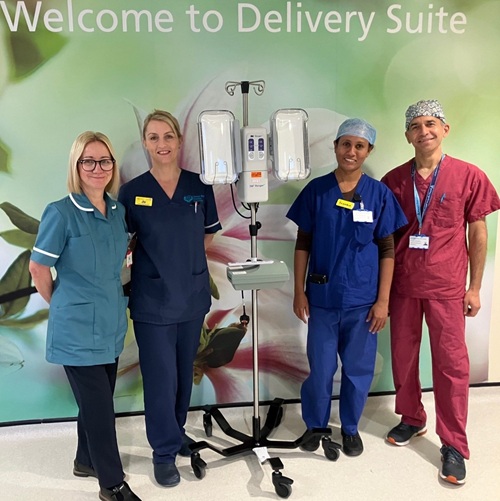
George Eliot Hospital, in line with national trends, has seen a rise in Major Obstetric Haemorrhage (MOH) and Post-Partum Haemorrhage (PPH). MOH has been identified by the Trust as one of five Patient Safety Incident Response Framework (PSIRF) priorities, with ongoing reviews and quality improvement workstreams in place to improve outcomes.
The new rapid infuser will allow clinical teams to stabilise patients more quickly, reduce the risk of serious complications such as organ failure or hysterectomy, and deliver high-level emergency care locally without delays or transfers.
Giuseppina Edwards, Transfusion Practitioner at George Eliot Hospital, said:
“Rapid infusion can be critical when managing major blood loss. Having this equipment means we can act immediately; stabilise patients faster and significantly reduce the risks associated with massive haemorrhage. This will make a real difference to maternal safety and emergency care outcomes for our patients.”
The investment also brings wider benefits to the NHS, including reduced pressure on ambulance services, fewer transfers to tertiary centres, and improved efficiency for clinical teams responding to critical incidents.
Lisa Harrison-Byrne, Fundraising Manager at George Eliot Hospital Charity, added:
“We are incredibly pleased to have been able to fund such an important piece of equipment. This is exactly the kind of impact our supporters enable — helping our hospital teams deliver the best possible care, when it matters most, for patients and their families.”
Thanks to charitable support, George Eliot Hospital is now better equipped to respond to major emergencies, improve survival outcomes, and continue providing safe, high-quality care for its local community.