
It also forecasts that interest rates will remain the same rather than falling, as previously forecast.
The BCC forecast is the first economic assessment by a business organisation since last week’s Spring Statement and renewed conflict in the Middle East.
While the current geopolitical situation remains highly uncertain, and could change the economic outlook considerably, the key points in the forecast are that GDP in 2026 has been revised down to 1.0% (from 1.2% in the previous forecast), with growth forecast of 1.3% in 2027, and 1.1% in 2028.
Global uncertainty is expected to push UK inflation higher than expected, reaching 2.7%, before easing to 1.9% in 2027.
Unemployment is expected to increase to 5.5% in 2026 (up from 5.1% in the previous forecast), and stay at that rate through 2027, due to persistent high labour costs and hiring uncertainty.
The interest rate is expected to remain at 3.75% this year, before cuts to 3.25% by the end of 2027.
Exports are projected to grow by just 0.7% in 2026 (down from 1.8% in the last forecast), as global uncertainty hits UK trade.
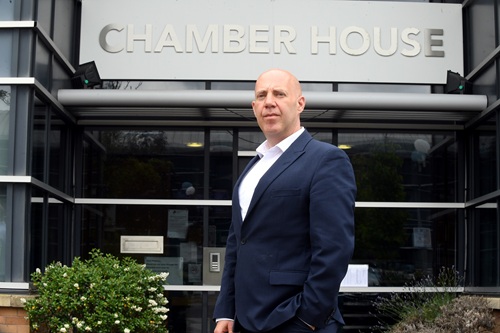
Corin Crane, chief executive of Coventry and Warwickshire Chamber of Commerce, said: “This is something of a downbeat reality check – with higher inflation and unemployment forecast, slower growth and a fall in exports and investments.
“It shows how quickly things can shift in the space of a week during such global uncertainty. The Chancellor presented a Spring Statement based on stability and, over the weekend, we’ve seen oil prices surging due to the conflict in the Middle East.
“Now, more than ever, businesses need to make sure they are working with organisations such as the Chamber to help them navigate through such unpredictable times.”
The Chamber’s latest Quarterly Economic Survey (QES) has just closed but its results will reveal how firms in the region were feeling at the start of 2026.
The QES is sponsored by Prime Accountants Group and director Steve Harcourt said the conflict would impact the regional economy.
He said: “The latest economic forecasts for 2026-27 are not great reading. In the budget last November the growth forecast for the UK was very low, which certainly gave cause for concern at the time.
“Therefore, any change in circumstance globally or for the local economy could lead to the position we now find ourselves in with the conflict in Iran leading to downgraded growth projection, leaving the economy in 2026 relatively stagnant.
“It now looks as though cost pressure from the rising price of fuel and energy will affect all businesses, leading to decisions to be made on price increases, wages growth and investment plans.
“From what we are hearing, the government is constantly reviewing the situation in the Middle East and may need to step in with financial assistance if fuel and energy costs continue to rise due to supply side economics, so businesses may have to watch this space, with global events having more and more of an impact on business in the region.”
David Bharier, Head of Research at the British Chambers of Commerce said: “The UK economy remains stuck in a low-growth pattern. Our forecast of just 1% growth in 2026 reflects weak productivity, subdued investment and cautious consumer spending.
“The recent escalation of conflict in Iran risks interrupting progress made on inflation. Higher energy prices linked to it could keep inflation firmly above the 2% target and lead the Bank of England to hold the interest rate longer than expected.
“Much depends on the duration of the conflict. Covid supply shutdowns showed how sudden stops put long term damage into the trading system.
“At the same time, elevated labour costs, stemming from national insurance increases and new employment regulations could weigh on hiring decisions. That has the potential to push the unemployment rate higher, making it especially difficult for younger people to enter the jobs market.
“Looking further ahead, our research shows that firms are increasingly adopting AI tools. While the immediate impact on employment is likely to remain limited, deeper integration could reshape the labour market more fundamentally. At the same time, it could offer an important opportunity to lift the UK’s persistently weak productivity growth over the longer term.”
Vicky Pryce, Chair of the BCC Economic Advisory Council, said: “Businesses expected to be steering through choppy waters again this year, but global events have just made that voyage even more turbulent.
“As a result, any forecasts prepared in the current unsettled environment have an extra degree of uncertainty attached to them with many factors outside the control of UK policy makers. Things could of course bounce back quickly if a fast resolution is found. However, it will take time for some of the supply constraints to ease through the system, as we discovered in previous crises, such as after the invasion of Ukraine and following the unwinding of the early Covid restrictions.
“But even before the latest turmoil in the energy markets, growth seemed in any case to be stuck in a rut, with the economy facing subdued business investment, trade headwinds and productivity challenges.
“Inflation looked to be heading towards the Bank’s target, but the BCC’s forecast suggests it will creep back up in the coming months and accelerate further while the current conflict continues. That will kick any likelihood of interest rate cuts in the foreseeable into touch.
“Rising unemployment, particularly among young people, will be a worrying drumbeat throughout this year, and likely to get worse given the likely slowdown in world growth from the effects of the conflict in the Middle East and the Gulf. That will have a widespread economic impact, hitting consumer and household spending and potentially also the housing market.”
UK economic outlook
UK GDP is expected to grow by only 1.0% in 2026, reflecting a landscape of weak productivity, business investment, consumer spending, and ongoing global uncertainty. It is then forecast to pick up to 1.3% in 2027 and then 1.1% in 2028.
The services sector continues to drive the UK’s limited GDP growth. However, even the pace of services growth is forecast to ease, to 1.2%. Construction and manufacturing are forecast to contract this year, by –1.3% and –0.3% respectively.
Business investment is expected to flatline this year (0%), a revision downwards from the previous forecast (0.9%). It is expected to pick up again, to 1.3% in 2027. The rapid adoption of AI that the BCC has seen from its own evidence could support productivity gains, but this is likely to begin beyond 2028.
While public finances have recently performed slightly better than expected, limited fiscal headroom means there remains a risk of further consolidation later in the forecast period.
Iran conflict could drive up inflation
Higher oil and gas prices linked to the current conflict in the Middle East are expected to push CPI inflation up to 2.7% by the end of 2026 (compared to 2.1% in the previous forecast). Energy prices are assumed to rise in the near term before easing later in the forecast period. Inflation is then forecast to ease back towards the Bank of England’s target in 2027, slowing to 1.9% by Q4 2027, as energy prices fall and wage growth moderates.
In the short term, wage growth is expected to remain elevated through 2026, staying just below 4%, before easing towards a more sustainable rate below 3% during 2027.
The near-term inflation path suggests the Bank of England may hold off further rate cuts, with the base rate forecast to remain at 3.75% in 2026. The forecast suggests the rate will fall to 3.25% in 2027.
Unemployment to rise further in 2026
The BCC expects the unemployment rate to rise to 5.5% in 2026 (up from the previous projection of 5.1%) with high labour costs dampening the hiring appetite of business. Unemployment is expected to remain elevated at 5.5% next year, before easing to 5.3% in 2028.
Youth unemployment remains an area of concern as labour costs and AI erode entry level jobs. It is expected to be 17% in 2026, peaking at 17.1% in 2027 before falling to 16.7% in 2028.
Trade outlook remains subdued
Export growth is forecast to slow to 0.7% this year (a downgrade from 1.8% in the last forecast). The downgrade reflects the impact of deepening global uncertainty, notably from the crisis in the Middle East and US tariff uncertainty.
The forecast for imports in 2026 has also been downgraded to 0.6% (from 1.4% in the previous forecast), reflecting weaker consumer demand and the depreciation in sterling. While exports are also expected to slow, the reduction in import growth means the overall contribution of net trade to GDP is expected to remain broadly stable, at around –2.4% in 2026 and at a similar level through the forecast period.