The survey, which is delivered in partnership with Prime Accountants Group and measures how business owners are feeling, is analysed by the Business Intelligence Service at Warwickshire County Council.
From the responses of businesses across the service and manufacturing sectors, it gives scores out of 100 where anything above 50 indicates growth and anything below 50 is negative.
It looks at a range of aspects of doing business in the region, including the outlook for employment, investment, confidence, and current and future order books for both domestic and overseas sales.
In the vast majority of indicators, there was a drop compared to the previous quarter but, crucially, overall confidence remained above 50 while the overall economic outlook had a score of 56.2.
Corin Crane, chief executive of Coventry and Warwickshire Chamber of Commerce, said: “The survey backs up everything we heard anecdotally at the end of 2025 that firms had been through a difficult and uncertain period. So many businesses were nervous about the Budget and the manufacturing sector had been hit by the JLR attack.
“However, what we started to see after the Budget was confidence starting to return and lots of things that had been put on hold were starting to move forward.
“The first few months of 2026 will provide an important indication of what is to come throughout the year. So, while there will be concern around this survey we have to take it in the context of the period it was carried out.”
Steve Harcourt, director of Prime Accountants Group, added: “This is yet another fascinating survey that shows exactly how businesses across Coventry and Warwickshire were feeling as the end of the year approached.
“I know from my own client base that there was a huge amount of uncertainty but the last few weeks of 2025 felt much more stable and we are all hoping that this year begins on much more solid foundations from which companies across the region can grow.”
Todd Williams, business intelligence analyst (economy and skills) at Warwickshire County Council, said: “Quarter four at a national level rose modestly primarily due to an increase in services output, alongside an uptick in domestic orders for the manufacturing sector. Nevertheless, overall demand is reported to be weakening both domestically and abroad. Global and domestic economic uncertainty were blamed for steepening job losses.
“Meanwhile, the latest QES results shows a different picture for the local economy. Local sentiment around domestic sales for the services sector show growth.
“Meanwhile, other sales areas are all in contraction with overseas sales for the manufacturing sector showing significant weakness. Overall investment showed continued weakness, alongside cashflow for the services sector. Potentially related to the JLR shutdown, cashflow for the local manufacturing sector retracted sharply in Q4 from a very strong Q3.
“Local concerns around labour costs remain significant for both the services and manufacturing sectors, with the manufacturing sector also being very concerned about raw material costs and utilities.
“Local recruitment efforts have fallen, with reduced difficulties recruiting. The vast majority of local manufacturing sector respondents indicate that they are currently operating below full capacity.
“The results show that the overall economic outlook index for Coventry and Warwickshire exceeding the national trend in many ways. Nevertheless, very weak local sentiments around both manufacturing and exports are a significant concern.”
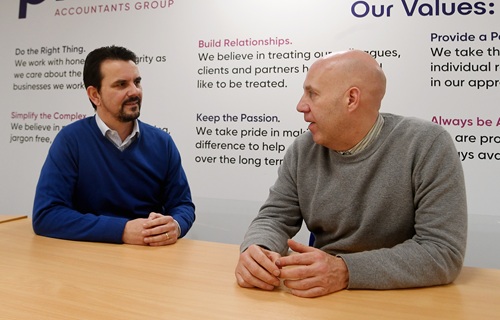
Pictured: Steve Harcourt (left) with Corin Crane
Summary of 2025 Q4 PMI:
Economic Outlook
Overall, 56.2, down from 59.9
Service Sector 57.2, down from 59.0
Manufacturing Sector 47.2, down from 71.6
Domestic Sales
Service Sector 52.8, down from 55.4
Manufacturing Sector 44.3, down from 73.7
Overseas Sales
Service Sector 45.8, up from 41.6
Manufacturing Sector 36.5, down from 41.7
Employment
Service Sector 70.7, down from 75.4
Manufacturing Sector 60.0, down from 83.3
Investment & Cashflow
Service Sector 46.0, down from 48.0
Manufacturing Sector 41.5, down from 68.0
Business Confidence
Service Sector 65.9, down from 66.6
Manufacturing Sector 50.0, down from 78.3