
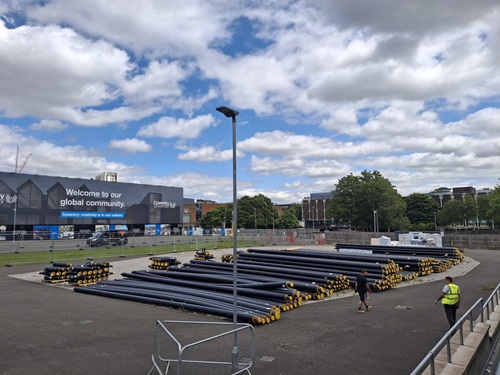
The project, supported by a £13 million Public Sector Decarbonisation Scheme (PSDS) grant administered by Salix Finance, is forecast to cut the University’s carbon emissions by more than 1,300 tonnes each year – over 20 per cent of its current fossil-fuel emissions arising from heating – advancing the University’s commitment to reach net zero by 2030.
The expansion will connect a mix of teaching, residential and student facilities across Coventry University to the city’s 6.6 km underground district energy network, which supplies low-carbon heat from the city’s waste-to-energy scheme.
Work commenced in August 2025 and will continue in phases through to spring 2026, delivered across city-centre locations.
To minimise disruption, pedestrian access will remain open throughout, and vehicle works will be carefully managed. A staged rollout approach will ensure continuity of academic, residential and support services during construction.
This latest phase builds on Bring Energy’s existing ‘Heatline’ concession with Coventry City Council, delivering low-carbon heat to the city centre and reducing reliance on fossil fuels.
Alongside the expansion of the heat network, the PSDS funding will support the installation of nearly 800 solar panels across the University estate. Together, these measures will reduce emissions while supporting the continued reliability of the network.
Bring Energy’s involvement spans the full lifecycle – design, build, integration and long-term operations – ensuring continuity with the existing Heatline network and delivering smarter, more efficient energy use across campus.
Mark Anderson, Concession Director for Birmingham & Coventry, Bring Energy, said:
“We’re delighted to be working with Coventry University and helping to deliver their plan to achieve net zero by 2030. By extending our Heatline network to these University buildings, we are delivering scalable, low-carbon energy infrastructure that supports the University’s sustainability goals while bringing long-term operational resilience.
“This project demonstrates how district energy networks can transform a campus’s carbon profile in a practical, cost-effective way.”
Mark Cammies, Chief Executive of Coventry University Enterprise Ltd, said: “We’re proud of the efforts we’re making for the Group to become net zero by 2030 and this project to connect our buildings to the district energy network is an important step on our journey.
“We’re excited to be entering this new phase of the works and we will make every effort to keep disruption to a minimum. We appreciate people’s patience and understanding during this time as we make these strides towards a greener and more sustainable campus.”
This expansion helps to reinforce Coventry University’s position as a leading institution in climate action, demonstrating practical decarbonisation at scale.
It also reflects Bring Energy’s broader strategy to grow its portfolio of low-carbon campus and city-centre networks, positioning the company as a trusted partner for universities and public sector estates seeking to deliver measurable carbon savings and future-proof energy systems.